Singing Apps and Online Lessons Compared: Prices, Free Tiers, and Who Each Fits
Updated September 17, 2026
Disclosure: We make Vocal Habit, one of the tools on this list. We put it last, and we compare it with every other tool in its own section, so you can weigh our bias for yourself. Where a competitor does something better than we do, we say so.
There is no single best way to learn to sing. There is a whole ecosystem of tools, and each one is good at something different. Some score your pitch while you sing pop songs. Some are video courses taught by a coach. Some are free utilities that show you your pitch as a line on a graph. And one option is not an app at all: a human voice teacher.
This guide compares 12 of them. For each one you get what it is (in the company's own words where we can), what it costs, what users praise and complain about, and who should skip it. The list is grouped by kind of tool, not ranked. How we researched it is explained after the list.
Prices checked September 17, 2026, in US dollars. App prices vary by country and by app store, and companies change them often, so confirm the price at checkout.
The short version
•
Want to sing real songs, with a score? Simply Sing or Yousician. Simply Sing's free tier stops at the range test, and Yousician's is a small sample.
•
Want a structured daily program on your phone? Sing Sharp, or Singing Carrots on the web and iPhone.
•
Want to be taught by a person on video? 30 Day Singer, Singing Success, or Ken Tamplin Vocal Academy.
•
Want to see your pitch while you sing, for almost nothing? Vocal Pitch Monitor, or Singing Carrots' free pitch monitor.
•
Want to train your ear, not just your voice? ToneGym, or VoSci's free interval and sight-reading tools.
•
Serious about singing, or something feels strained? A voice teacher.
•
Want a free practice routine that scores your pitch? Vocal Habit (ours) in a browser with no signup, or Sing Sharp's limited, ad-supported free version on a phone.
At a glance
Tool
Kind of tool
Good fit for
Free option
Paid price (US)
Simply Sing
Phone app, songs
Beginners who want to sing pop songs in their key
Range test and song browsing; no free songs
About $15/month, or $60 to $90/year
Yousician
App, lessons and songs
Beginners who like a game-style path, and people learning an instrument too
A small sample
$19.99/month or $119.99/year (singing only)
Sing Sharp
Phone app, exercises
A guided daily exercise program with video demos
A limited free version with ads
$19.99/month or $99.99/year
Singing Carrots
Web and iPhone
Pitch practice, range tools, and an AI practice coach
Range test, pitch test, pitch monitor
From $39.99/quarter or $119.99/year (Starter)
Vocal Pitch Monitor
Phone app, pitch graph
Watching your pitch on any song or exercise
Free on Android (ads)
$1.99 on iPhone
ToneGym
Web and app, ear training
Hearing intervals, chords, and melodies
3 games a day, plus tools
$13.95/month or $74.99/year
VoSci
Web, library and tools
Understanding the voice, and measurement beyond pitch
7 tools (free account) and a large library
Not published
30 Day Singer
Video course
A teacher-led course at a low yearly price
About 10 sample lessons
$129/year
Singing Success
Video course, coaching
Contemporary singers who want a teacher-designed course on mix, range, and style
YouTube channel and articles
$30/month or $360 lifetime
Ken Tamplin Vocal Academy
Video course, coaching
Committed contemporary and rock singers who want a long curriculum
Large YouTube channel
$49 one-time (short course), or $29 to $399/month
A voice teacher
Person
Anyone serious, or anyone with a specific problem
Free trial lessons are common
About $40 to $60 per 30 minutes
Vocal Habit
Web, exercises
A free daily practice routine that scores your pitch
Everything
Free
Features compared
Tool
Platforms
Account needed
Automatic pitch feedback
Human feedback
Song library
Video lessons
Simply Sing
iPhone, Android
Yes
Live, plus a score
No
Yes
Short warm-up videos
Yousician
iPhone, Android, Mac, PC
Yes
Live, plus a score
No
Yes
Yes
Sing Sharp
iPhone, Android
Yes (guest mode listed)
Live, plus a score
No
Song steps via Apple Music
Yes
Singing Carrots
Web, iPhone
For saving, videos, the pitch game, and paid features
Live, plus a score
Top tier only, monthly
Song finder by range; your own MIDI melodies (paid)
Yes
Vocal Pitch Monitor
Android, iPhone, Windows
No
Live line, no score
No
No
No
ToneGym
Web, iPhone, Android
For games (range test and warm-up tools work without one)
In 3 singing games and a sight-singing tool
No
No
No
VoSci
Web
Yes, for tools
Yes, in cents
No
No
No
30 Day Singer
Web
Yes
No
Yes, video replies
No
Yes
Singing Success
Web
Yes
No
VIP coach Q&A, paid lessons
No
Yes
Ken Tamplin Vocal Academy
Web, iPhone, Android (course player)
Yes
No
Yes, coach video replies and live classes
No
Yes
A voice teacher
In person or video call
No
No
Yes
Your choice
Live
Vocal Habit
Web (desktop and phone)
No
After each pattern, per note; live cents in Guided mode
No
No (import your own melody)
No
Simply Sing
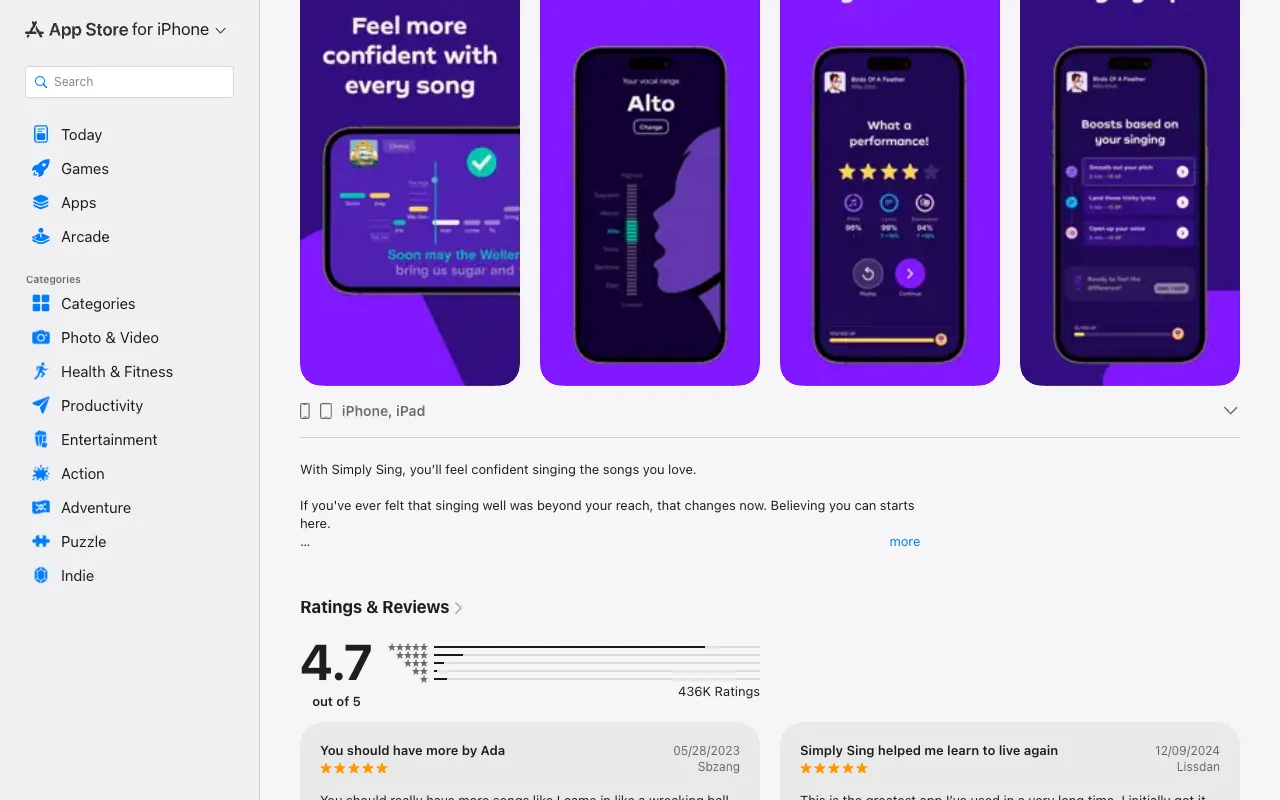
Simply Sing's App Store listing, showing its song screen and post-song scores.Screenshot by Vocal Habit, September 17, 2026.
Good fit for: beginners and shy singers who want to sing real pop songs in a comfortable key.
Kind of tool: a phone and tablet app from Simply (formerly JoyTunes), the company behind Simply Piano. iPhone, iPad, and Android. No web version.
In their words: "Simply Sing adapts all songs to your unique vocal range." The App Store listing calls it "Much More Than Karaoke."
Simply Sing starts with a vocal range test, assigns you a voice type, and then moves every song into your key. While you sing, it tracks your notes in real time. Afterward you get a star rating and scores for pitch, lyrics, and "expression," plus XP toward levels. Short daily warm-ups of around five minutes cover pitch, breathing, and confidence.
Price: Simply does not publish prices on its site; they appear in the app and vary by country and store. The US App Store lists unlabeled subscription prices including $14.99 and $19.99 (monthly, per a third-party review) and $59.99 and $89.99 (yearly), plus lower-priced items that may be offers. Expect roughly $15 a month or $60 to $90 a year. The free account gives you the range test and lets you browse songs, but you can't sing a song without paying. The 7-day free trial comes only with a yearly plan.
Ratings: 4.7 on the App Store (about 436,000 ratings) and 4.4 on Google Play (about 286,000 reviews).
What users like:
•
The key changes. Even critical reviewers like that songs move to fit their voice. One wrote that it helped them "move from thinking I was Alto to realizing I was a Mezzo!"
•
It builds confidence, and several reviewers found the breathing and warm-up guidance useful.
What users complain about:
•
The paywall. A highly upvoted comment in a large r/singing thread says you hit it "without even one free song to test things out."
•
Detection and range accuracy. Reviewers report notes not registering and being placed in the wrong voice type. One classically trained reviewer said the scoring leaves "no room for vibrato."
•
Library size. Paying subscribers ask for more songs.
Many of these reviews predate a 2026 update that Simply calls "the new Simply Sing," so some complaints may no longer apply.
Skip it if: you want to try before paying, you practice on a laptop, or your goal is technique work on registers and resonance rather than songs.
Compared with Vocal Habit: Simply Sing does several things we don't: a licensed song library in your key, a game-like level system, video warm-ups, and native apps with an account that follows you. For a beginner whose goal is to enjoy singing favorite songs, it is the more complete and more fun product. Vocal Habit is free with no account and runs in a browser, and it is built around warm-up and technique exercises you can practice with daily, rather than songs, with a per-note report of how many cents sharp or flat you were.
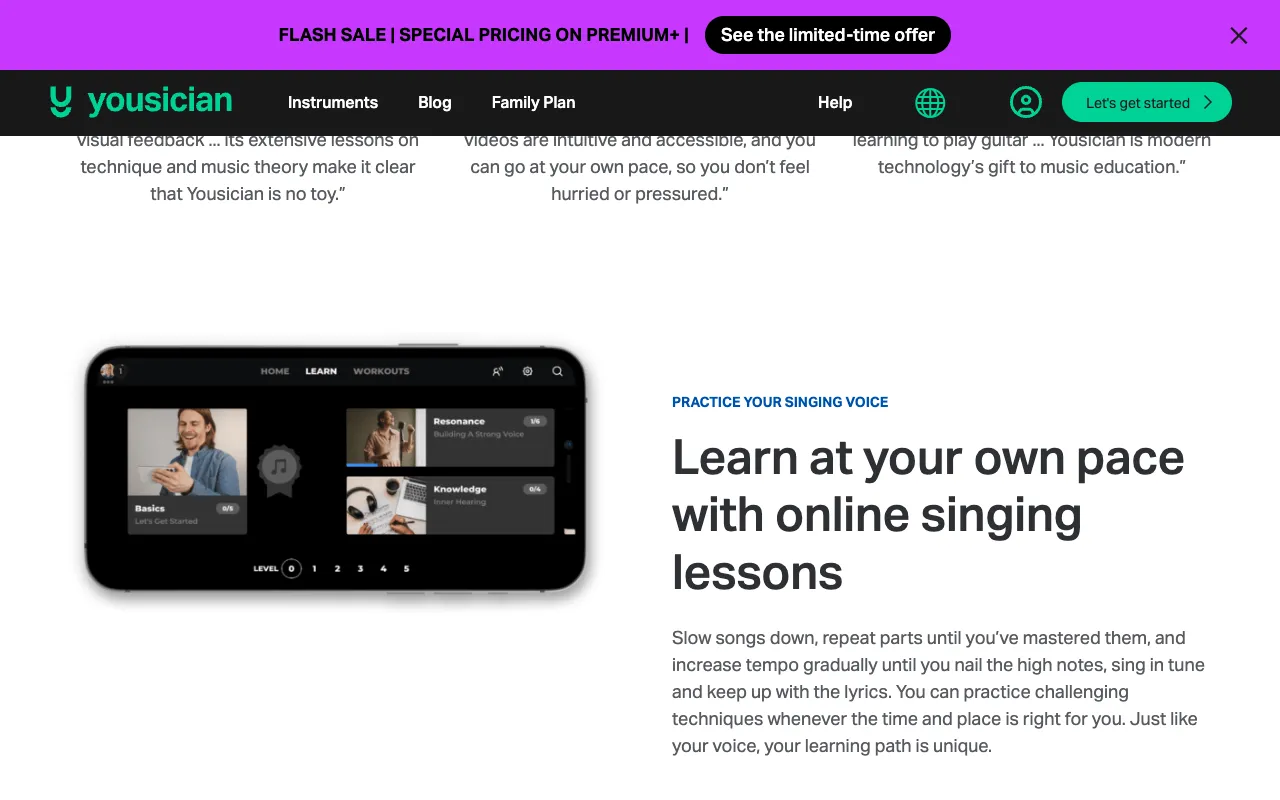
Yousician's singing path is split into levels, with themed lessons.Screenshot by Vocal Habit, September 17, 2026.
Good fit for: beginners who like a game-style learning path, and anyone also learning guitar, bass, piano, or ukulele.
Kind of tool: a multi-instrument learning app from Yousician (Helsinki, founded 2010). Singing is one of five instruments. iPhone, Android, Mac, and PC. No browser version, and Chromebooks aren't supported.
In their words: "Learn to sing with interactive lessons." And: "The app gives you instant feedback on the timing and accuracy of your singing."
Notes scroll across a lane with the lyrics while the app scores your pitch and timing. The singing path runs through five levels of video lessons, exercises, pitch games, and songs, and Yousician says it covers "breath support, melody, harmony, intervals, scales, vocal range, tone and pitch control, ear training, solfege." Practice tools let you slow a song down, loop a section, and transpose it to your range.
Price: there's no singing-only plan. Premium lets you pick one instrument (singing counts) for $19.99 a month or $119.99 a year on the US App Store. Premium+ covers all five instruments and adds licensed popular songs for $29.99 a month or $179.99 a year; the website was running a sale on it when we checked. The free tier is a sampler, and the 7-day trial needs a card.
Ratings: 4.6 on the App Store (about 138,000 ratings) and 4.4 on Google Play (about 526,000 reviews), both marked Editors' Choice. These cover the whole app, and most reviews are about guitar.
What users like:
•
Seeing their pitch. One App Store reviewer valued "visual confirmation that I am actually singing in pitch."
•
A path that starts from the basics and moves slowly.
•
Song practice tools: slowing down lyrics, looping, transposing.
What users complain about:
•
The free tier is thin. Recent reviewers say content locks after the first lesson.
•
Detection errors, including octave mistakes: "it thinks I'm singing an octave higher than I am and says I failed."
•
Singing lessons lean on songs Yousician wrote, and the licensed catalog costs extra.
•
Singers pay the same as guitarists for a product built guitar-first.
A 2021 r/singing thread sums up the ceiling of every pitch-scoring app, ours included: it "can only differentiate pitch but it can't tell you why your pitch is off."
Nick Stockton's review for American Songwriter found "a solid combination of legitimate instruction and fun exercises," but called the song selection limited and the badges and streaks "a form of emotional manipulation."
Skip it if: you only want singing and don't want to pay guitar prices, you use a Chromebook, or you dislike game-style interfaces.
Compared with Vocal Habit: Yousician is a far larger product, with video teachers, a five-level curriculum, hundreds of songs, harmony and ear-training workouts, a live pitch line, and synced apps on every major platform. If you want lessons, songs, and a curriculum and are willing to pay, it is the more complete choice. Vocal Habit is free, needs no account or install, runs in a browser (including on Chromebooks), and is built around a daily exercise routine instead of a song path.
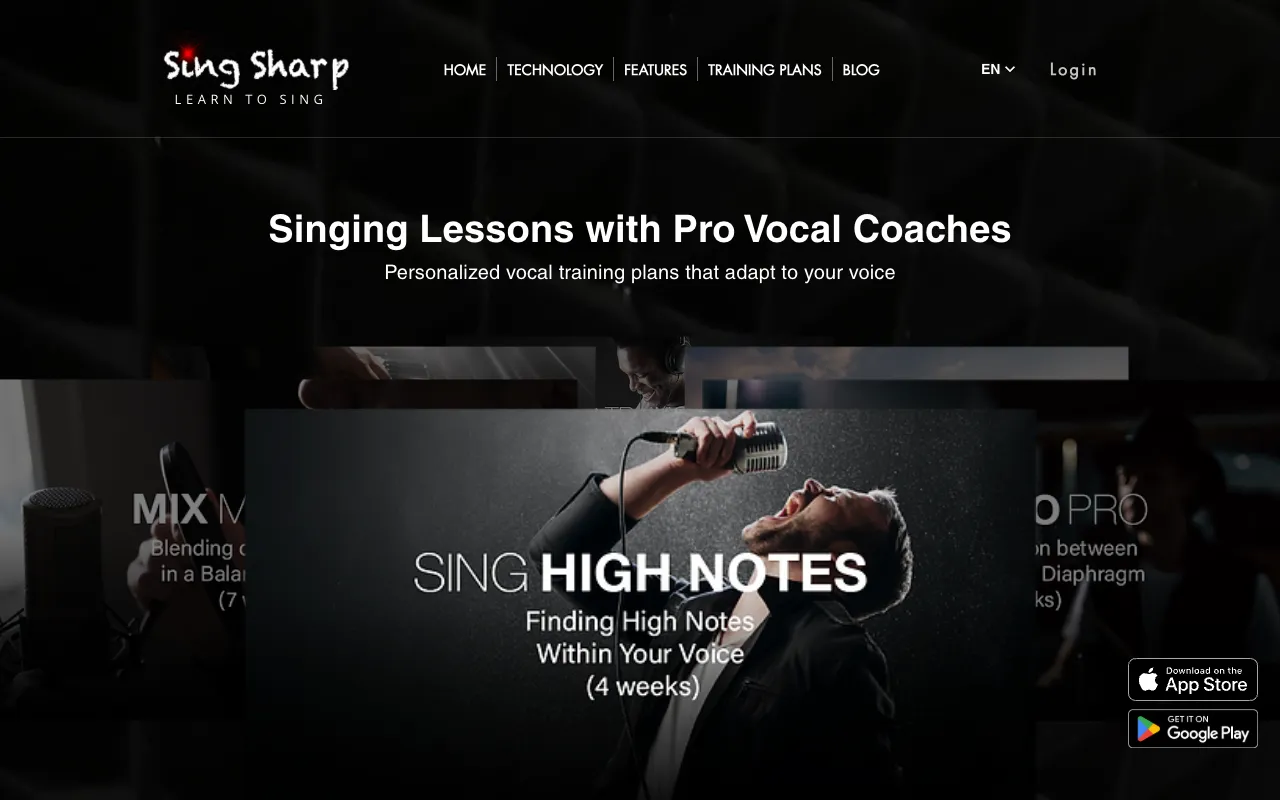
Sing Sharp's homepage leads with coach-built training plans.Screenshot by Vocal Habit, September 17, 2026.
Good fit for: self-taught adults who want a teacher-like daily exercise program on their phone.
Kind of tool: a phone app from Sing Sharp Limited in Hong Kong, on the App Store since 2013 and still updated. iPhone, iPad, and Android.
In their words: "Personalized vocal training plans that adapt to your voice." On its method: it plays exercises "like a singing teacher playing the piano just for you."
Sing Sharp opens with a range and voice analysis, then builds exercises to fit. It combines video demos from vocal coaches, real-time pitch tracking with scores, breath detection through the mic, ear training, harmony work, and an AI chat tutor called Voice Mentor. Its named programs include Sing High Notes (4 weeks), Mix Mastery (7 weeks), and Vibrato Pro (3 weeks).
Price: the website shows no prices. The US App Store lists memberships at $19.99 a month, $39.99 for 3 months, or $99.99 a year, plus a second yearly option at $29.99 (we couldn't tell which one new users see). The free version has ads, and removing them costs $2.99. Users describe a 3-day trial that converts to a yearly charge.
Ratings: 4.3 on the App Store (about 13,600 ratings) and 4.3 on Google Play (about 87,000 ratings).
What users like:
•
Structure that feels like lessons: "a clear set lesson plan, starting with very well made videos that teach."
•
Personalization to their range.
•
Improvement over time. One reviewer a year in said their "range and ability to sing in tune has improved significantly."
•
Some find the ad-supported free version enough, though user reports on how much it includes differ.
What users complain about:
•
Money pressure: frequent ads, trials that turn into yearly charges, and song steps that reviewers say need an Apple Music subscription.
•
Pace. A detailed 2026 Google Play review says "The drills can't be slowed down" and that the app jumps into high-note drills before teaching the basics of mixing.
•
Detection and latency with headphones, which one reviewer said breaks the rhythm exercises.
•
AI feedback that one reviewer found "repetitive and generic."
We found no third-party expert review and little Reddit discussion. The two detailed reviews we found online are from competing products.
Skip it if: you can't yet match pitch reliably, you dislike ads, or you want to practice on a computer.
Compared with Vocal Habit: Sing Sharp offers more: coach videos, breath detection, ear and harmony training, an AI tutor, named multi-week programs, and native apps in 63 languages. Someone who wants a guided, video-led program and is happy to pay will get more from it. Vocal Habit is free with no ads or trial, runs in a browser, and lets you slow exercises down with a tempo slider or hold each note in a hold-and-match mode.
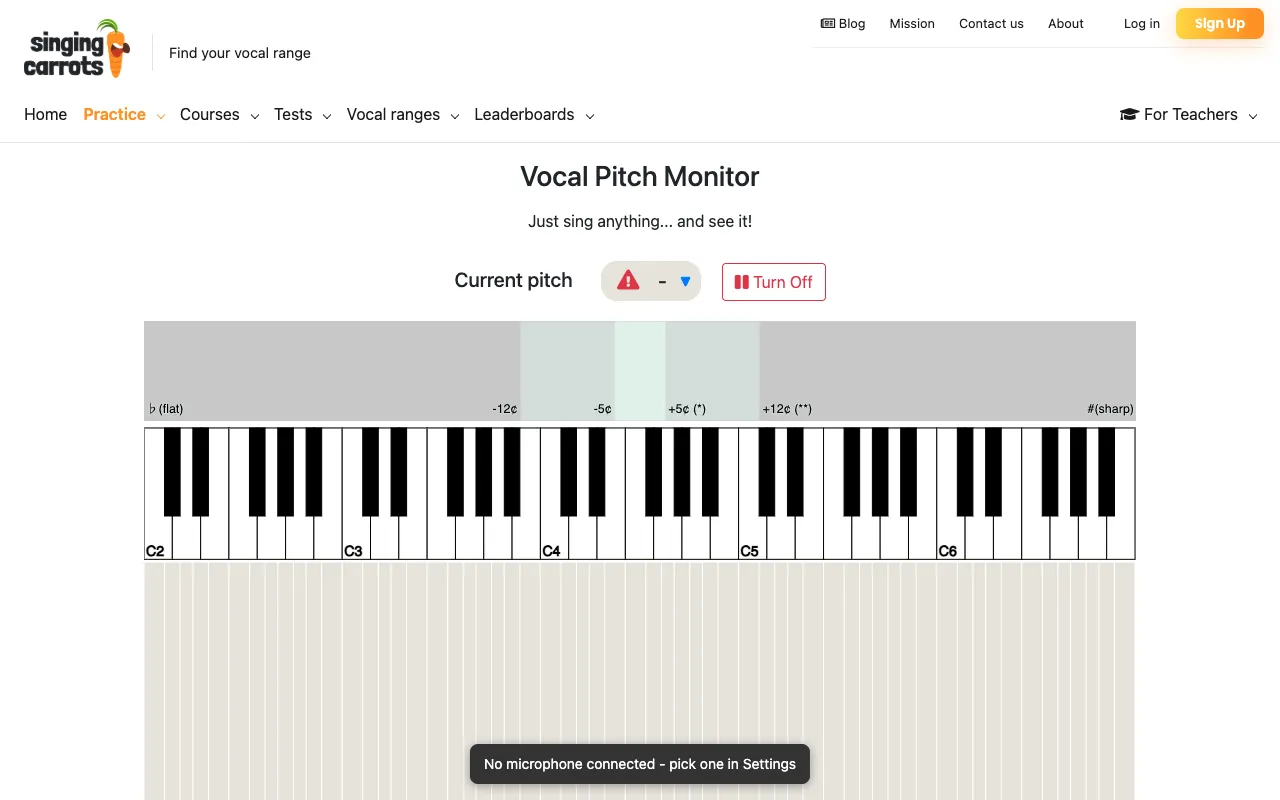
Singing Carrots' free pitch monitor works in the browser without an account.Screenshot by Vocal Habit, September 17, 2026, with no microphone connected.
Good fit for: beginners who want free pitch and range tools, and self-directed learners who want an AI-planned practice session.
Kind of tool: a browser-based platform from Singing Carrots Limited, a UK-registered company; the idea began in Amsterdam in 2018 and the first version launched in 2019. There's an iPhone app since June 2026. No Android app; Android users use the website.
In their words: "Your Personal AI Vocal Coach. It listens to you sing, analyzes your pitch and range, and guides you through short daily sessions tailored to your voice." They also describe its limits plainly: "It complements a human teacher rather than replacing one."
Without an account you can use a vocal range test, a pitch accuracy test, a live pitch monitor, and a song search by vocal range. Paid plans add a chat-based AI coach that plans sessions from your history, two courses, and practice on your own melodies from MIDI files. A free account is needed for the pitch-training game (with levels and leaderboards) and the video library; we couldn't confirm how much of either is free. Exercises show your pitch as a line against the target notes and score how many notes you hit.
Price: the pricing page asks you to take an assessment first. The checkout pages it links to show Starter at $39.99 every 3 months or $119.99 a year, and Self-Study at $99.99 every 3 months or $299.99 a year. A top Guided tier adds a monthly video review from a voice teacher; we couldn't find its price. First purchases carry a 30-day money-back guarantee.
Ratings: 4.1 on Trustpilot (106 reviews, only 7 in the past year) and 4.0 on the App Store (7 ratings, new app).
What users like:
•
Visible pitch practice. One Trustpilot reviewer wrote they "100% can see massive improvement by practicing daily."
•
The free tools, which some Reddit users recommend. One said the free version was "very helpful" with "zero prior singing experience."
•
Paying users like that the AI coach remembers past sessions.
What users complain about:
•
Seeing prices only after a quiz and an email, plus countdown offers. One r/singing commenter said the "this price is only available for 30 mins" message made them suspicious.
•
Technical issues: the mic not detected, and notes cutting out on newer iPhones (the founder has replied with a workaround).
•
Some doubt the range results.
Singing Carrots has published its own outcome data showing pitch accuracy gains over four weeks. The post notes there was no control group.
Skip it if: you want to see prices before giving an email, you're an advanced singer (the company's own blog says advanced singers have "probably outgrown what it offers"), or you want a native Android app.
Compared with Vocal Habit: Singing Carrots is a much broader product: courses, a video library, an AI coach, a pitch game, a song finder by range, playback of your own recorded singing, an iPhone app with synced accounts, and paid access to a human teacher's feedback. Its free pitch monitor draws a continuous live pitch line, which we deliberately don't. A beginner willing to pay about $10 a month (billed yearly) gets far more structure there. Vocal Habit is free with no signup, including its daily practice routine, while Singing Carrots' AI-planned sessions and courses are paid.
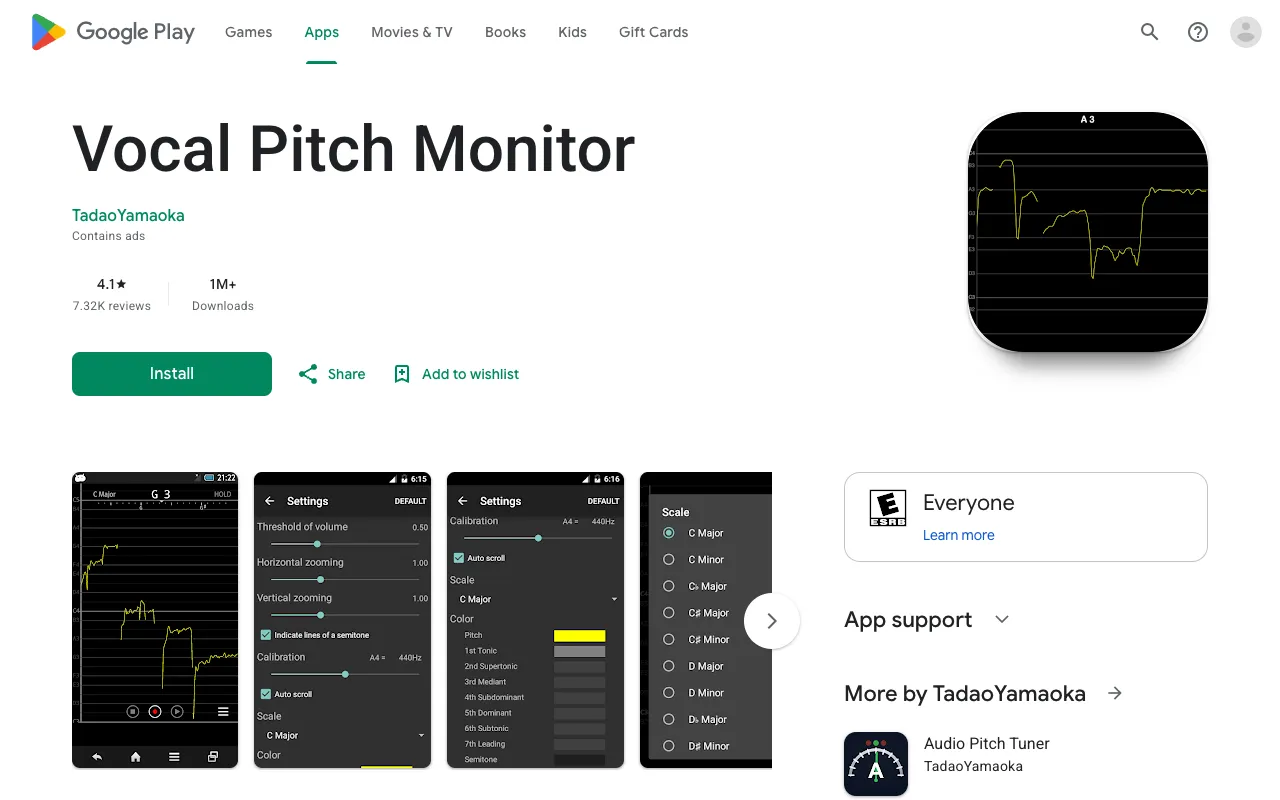
Vocal Pitch Monitor on Google Play: the whole app is one scrolling pitch graph plus settings.Screenshot by Vocal Habit, September 17, 2026.
Good fit for: singers who already have something to practice and want to see whether they're on the note.
Kind of tool: a small pitch-graph app by solo developer Tadao Yamaoka. Android (free with ads), iPhone and iPad ($1.99), and Windows ($1.99, new in 2026). No account. (vocalpitchmonitor.com is a parked domain, not the developer's site.)
In their words: the store description opens by saying it "displays the pitch of the sound inputted from the microphone on a graph in real time."
That is exactly what it does. You sing, and a line moves across a grid of notes. There are no exercises, no scores, and no lessons. You bring the reference: a piano, a song, or exercises from a teacher. You can record and play back, set a key, and freeze the display.
Price: free on Android with ads, $2.99 for the ad-free Pro version, $1.99 on iPhone and Windows (the Windows version has a free trial). One-time purchases, no subscription.
Ratings: 4.1 on Google Play (about 7,300 ratings, 1M+ downloads) and 2.6 on the App Store (42 ratings). The gap is mostly about the iPhone version, which hasn't been updated since January 2021.
What users like:
•
It shows you plainly what you sang. The most helpful Play review says it gives "a very objective visual display of what everyone else is hearing."
•
It's simple and fast. On Reddit, "use vocal pitch monitor" is a standard answer to pitch-matching questions.
•
It works for vibrato, range checks, instruments, and speech-pitch practice.
What users complain about:
•
The line jumps octaves on low voices and vocal fry.
•
Recording is clunky: crashes, files you can't rename, and a delete button next to load.
•
No guidance at all: "I don't see any instructions on how to use this."
•
A few warn about dependence: "I sing very good and accurate when I see in the app, but without this app, I can't sing."
Some well-known coaches and creators have named it publicly, including the Wings of Pegasus YouTube channel. We found no study of this specific app.
Skip it if: you need to be told what to practice, you want progress tracking, or you have a very low voice. Similar options, free to download with in-app purchases, include Nail the Pitch (iPhone and Android, with ads) and Singscope (iPhone).
Compared with Vocal Habit: Vocal Pitch Monitor shows a continuous pitch line and works with any song, exercise, or instrument, which Vocal Habit does not. It also has native apps and a decade of use behind it. Vocal Habit gives you the exercises and the piano, scores each note against the target, and keeps a practice history, free in any modern browser, including on a phone. Many singers would use both, with exercises in one and free-form song practice in the other.
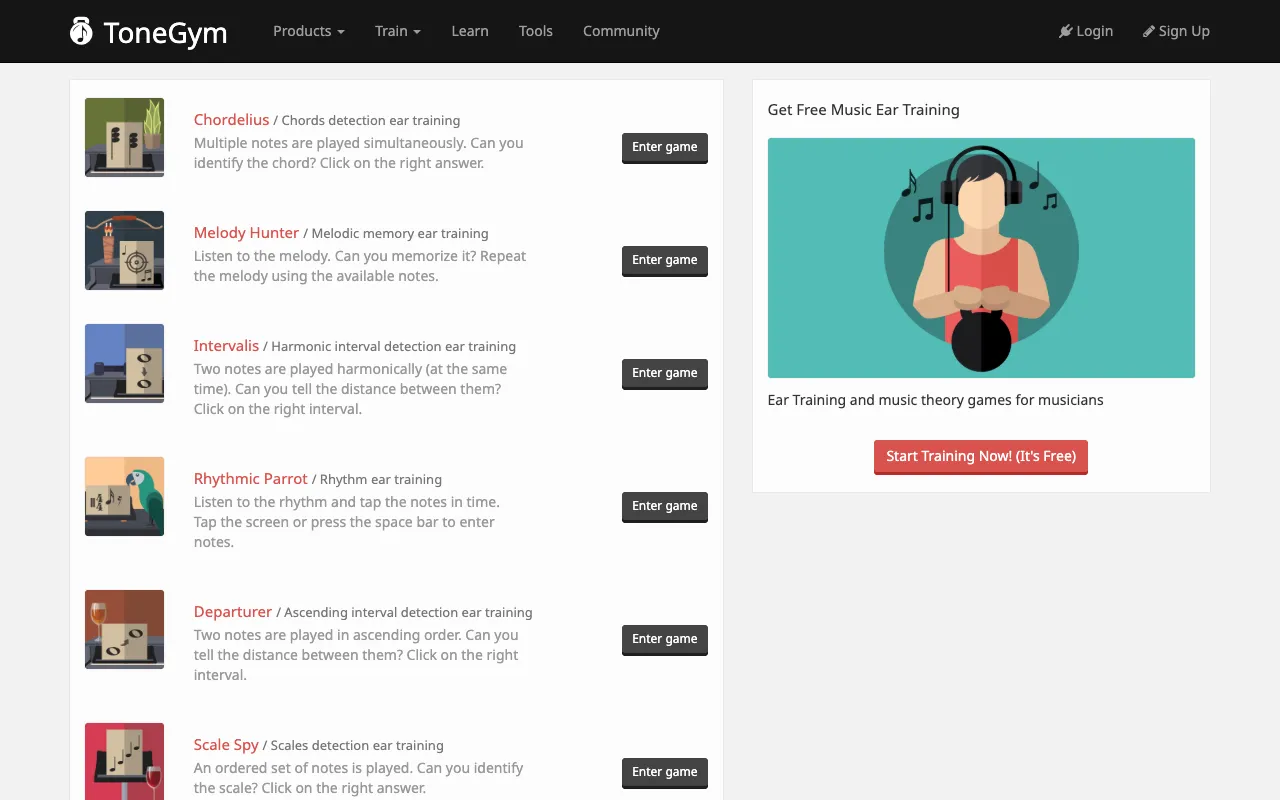
ToneGym is built around short ear-training games.Screenshot by Vocal Habit, September 17, 2026.
Good fit for: singers who want to build their ear and musicianship alongside separate voice training.
Kind of tool: a gamified ear-training platform from SoundGym. Long-running on the web, with new iPhone and Android apps in 2026 (the iPhone app launched in August). It is not a voice-technique course.
In their words: "Train Your Ears. Play Better." Practice "takes 10 to 15 minutes a day."
Each day you get a workout of short adaptive games covering intervals, chords, scales, rhythm, melody, and sight-reading. Most games train listening. Three ask you to sing into the mic (Melody Jay, Solfègiator, and Interval Barks), and a free sight-singing trainer listens too. ToneGym also has a free vocal range test and a free warm-up player with piano accompaniment by voice type; the warm-up player plays along but doesn't score you.
Price: free with no time limit, but the free daily workout repeats the same 3 games. Pro unlocks all 17 games for $13.95 a month or $74.99 a year on the US App Store. Website prices appear after you log in, and one 2026 blog by a competing app lists higher prices, so check yours. There's no Pro trial.
Ratings: too new in the app stores to mean much (4 App Store ratings). There's no Trustpilot page.
What users like:
•
Daily games that keep people practicing, with real listening gains.
•
Long-term subscribers feel Pro is worth it: "If you plan to train you ears on an ongoing basis it's not expensive."
What users complain about:
•
The singing games can feel strict: one user said Melody Jay "requires almost cent-perfect singing," and another reported octave misreads. These posts are from 2021 and 2022, and ToneGym said it updated its pitch recognition in March 2022.
•
Launch bugs in the new iPhone app, including people locked out right after paying.
•
Price, compared with other ear-training apps.
Most feedback we found comes from ToneGym's own community forum, and most users are instrumentalists.
Skip it if: you want to learn vocal technique. ToneGym doesn't assess breath, registration, or tone, beyond written tips on its warm-up page.
Compared with Vocal Habit: ToneGym covers ground we don't touch: interval, chord, and scale recognition, sight-singing, theory tools, leaderboards, and community. Vocal Habit does the opposite job, with voice-technique exercises, piano accompaniment, and per-note pitch scoring, free, with no account. The two do different jobs, so you could use ToneGym for your ear and Vocal Habit for your voice.
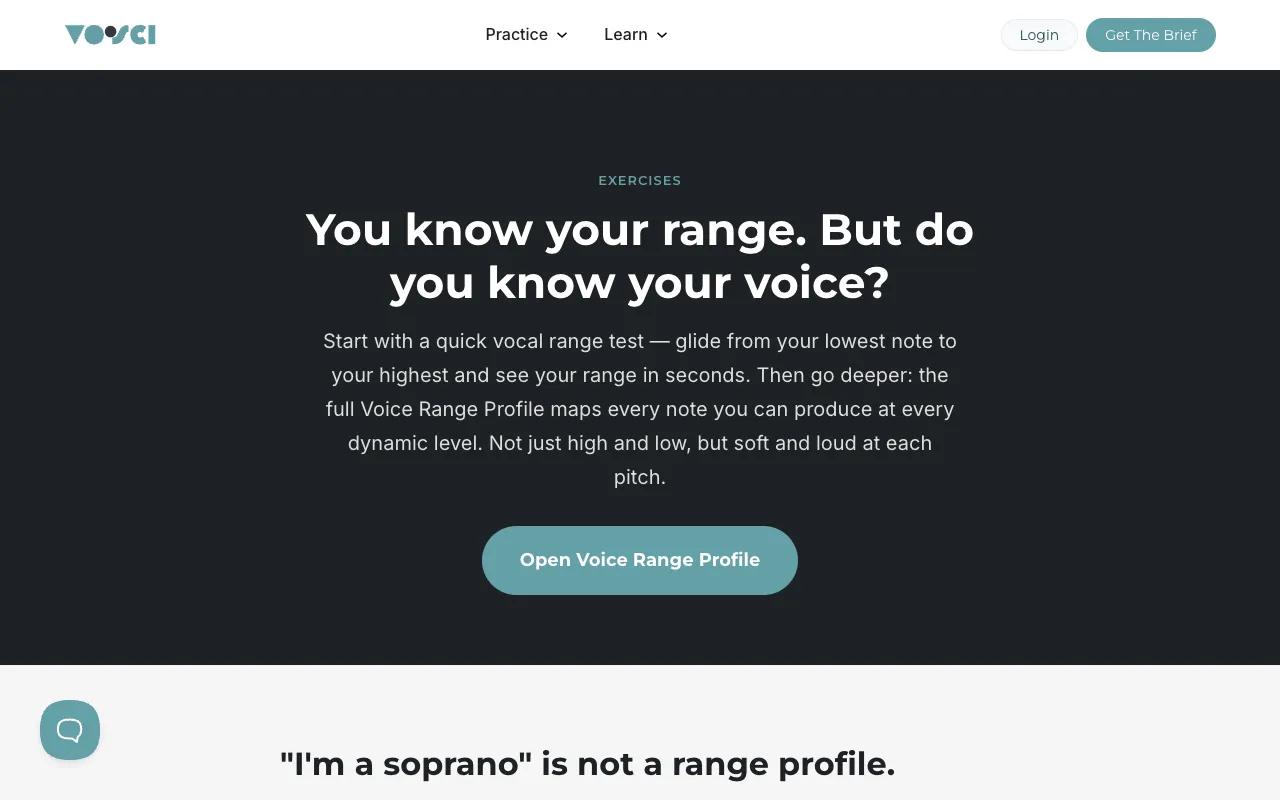
VoSci's Voice Range Profile maps soft and loud singing at each pitch.Screenshot by Vocal Habit, September 17, 2026.
Good fit for: singers who want to understand how the voice works, and singers or teachers who want measurements beyond pitch.
Kind of tool: a free voice-science library plus seven browser tools, from VoSci, founded by voice teacher Josh Manuel (Louisville, Colorado). Browser only. Not to be confused with VoiceScienceWorks, a different organization.
In their words: "Vocal pedagogy, grounded in science." And: "Built by voice teachers to bridge the gap between lesson day and the practice room."
Anyone can read the library without an account. It holds a lexicon of more than 200 terms, 168 free lessons, 31 articles, and a podcast. The tools need a free account (email sign-in, no card): a Voice Range Profile that maps "soft and loud at each pitch," a spectrogram with vowel and resonance overlays, pitch matching and interval trainers scored in cents, a sight-reading trainer, scales and arpeggios in all keys, and Vocal Function Exercises (an established voice-therapy protocol).
Price: the tools and library are free. Paid plans (courses, adaptive Practice Paths, teacher features) exist, but prices aren't published at the moment, and Practice Paths are marked "currently unavailable." Teachers with an Academy membership (price not published) can connect 2 students free, then pay $5 a month per student.
Ratings: none. There's no app store app and no Trustpilot page, and we found essentially no public user reviews. The product is young, so we can't report user themes without inventing them.
Its view on pitch apps: VoSci takes a clear position. Its guide to singing in tune has a section titled "Why Most Apps Miss the Point," arguing that watching a pitch display "builds dependence on the tool rather than the internal model the tool is supposed to develop." VoSci says its tools have you listen and imagine the note first, then sing, with live cents feedback as you go. See the section below on whether apps work for the other side of that argument.
Skip it if: you want to press start on a guided session today (the guided product is paid and paused), or you want a phone app.
Compared with Vocal Habit: VoSci measures more than we do (loudness across your range, resonance on a spectrogram), has musicianship tools we lack, a much deeper reference library, a named voice-pedagogy expert behind it, cross-device accounts, and teacher features. Vocal Habit needs no email at all, and it offers a ready-made daily practice routine with piano, a beginner course, and song import.
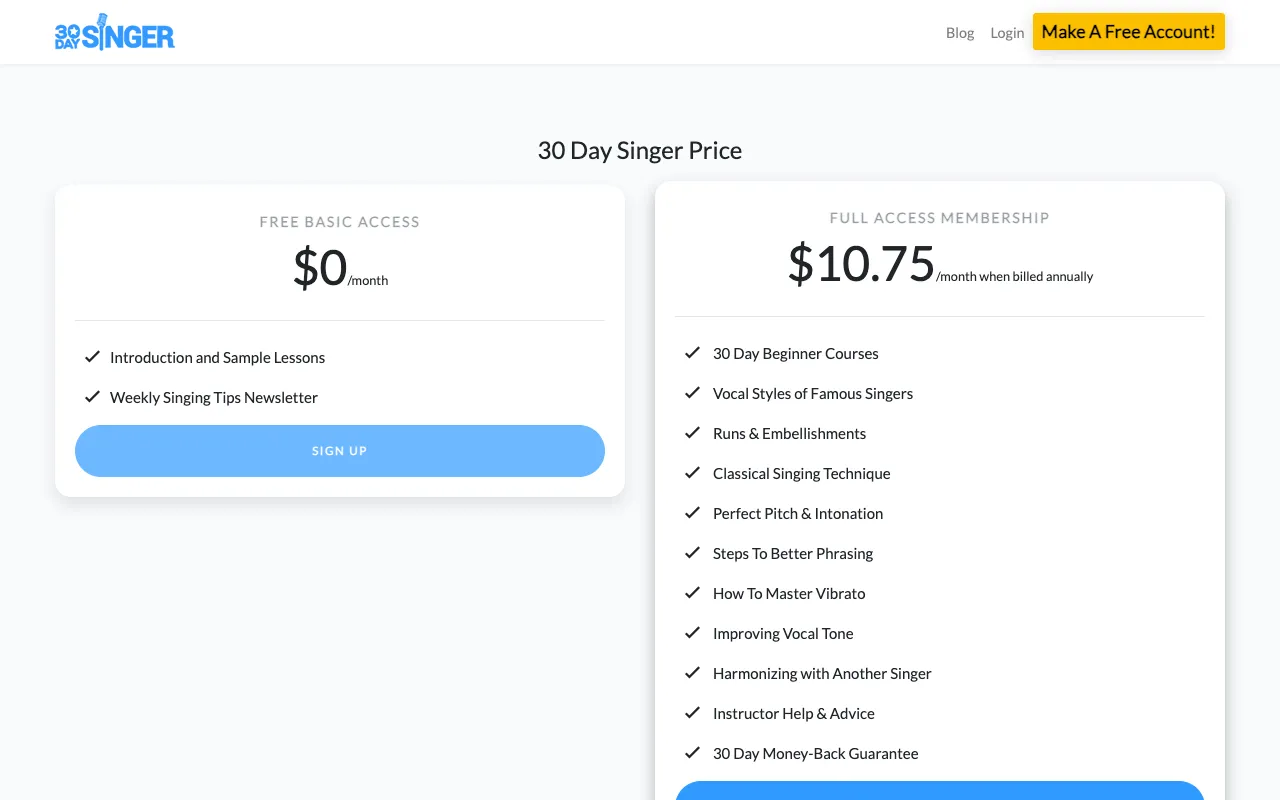
30 Day Singer's public pricing page.Screenshot by Vocal Habit, September 17, 2026.
Good fit for: adult beginners and hobbyists who want to be taught by a person on video, at a low yearly price.
Kind of tool: a web-based video course from 30 Day Lessons Inc. in San Francisco, the sister company of Guitar Tricks. No iPhone or Android app; it runs in a mobile browser.
In their words: "Become a better singer in only 30 days!" And on feedback: "Simply submit a video of yourself singing and receive a video response from one of our instructors."
Two 30-day beginner courses (with high-voice and low-voice paths) lead into style courses for pop, R&B, jazz, folk, classical, and more. The public catalog lists over 100 technique, ear-training, and style tutorials, plus an archive of 249 live streams. Instructors include Camille van Niekerk and Abram Poliakoff. There's no automatic pitch detection; feedback comes from instructors, by video.
Price: a free account unlocks about 10 sample lessons. Full Access is $129 a year ($10.75 a month billed yearly) with a 30-day money-back guarantee. The monthly price isn't on the public pricing page; older sources list $29 or $29.95. Live one-on-one Zoom lessons cost extra ($75 for 30 minutes). The site also links a 14-day free trial page, which reviewers have used; check whether it's offered when you sign up.
Ratings: 3.9 on Trustpilot (216 reviews, 9 in the past year). No app store listing.
What users like:
•
The instructors. "Camille's instruction is way better than most teachers I've had," wrote one Trustpilot reviewer.
•
Value: "for the price of ONE live voice lesson you get access to a lot."
•
A foundation. A 2024 r/singing commenter found it "helpful for understanding the elements of singing."
What users complain about:
•
Support and billing: unanswered emails, surprise annual charges, and login trouble.
•
No real-time feedback. "The lack of real time feedback and the assumption that I could already pitch match was frustrating."
•
Navigation, and beginner lessons some found too hard.
Skip it if: you can't yet tell whether you're on pitch, you want an app, or you want game-style practice.
Compared with Vocal Habit: 30 Day Singer has what we don't: human teachers explaining and modeling technique, human video feedback, style and performance courses, and far more content. Vocal Habit has something two 30 Day Singer reviewers said they missed: automatic pitch feedback, free, with exercises moved to your voice part (scored after each pattern, or live note by note in Guided mode). A 30 Day Singer student could learn technique from the videos and check pitch in a scoring tool.
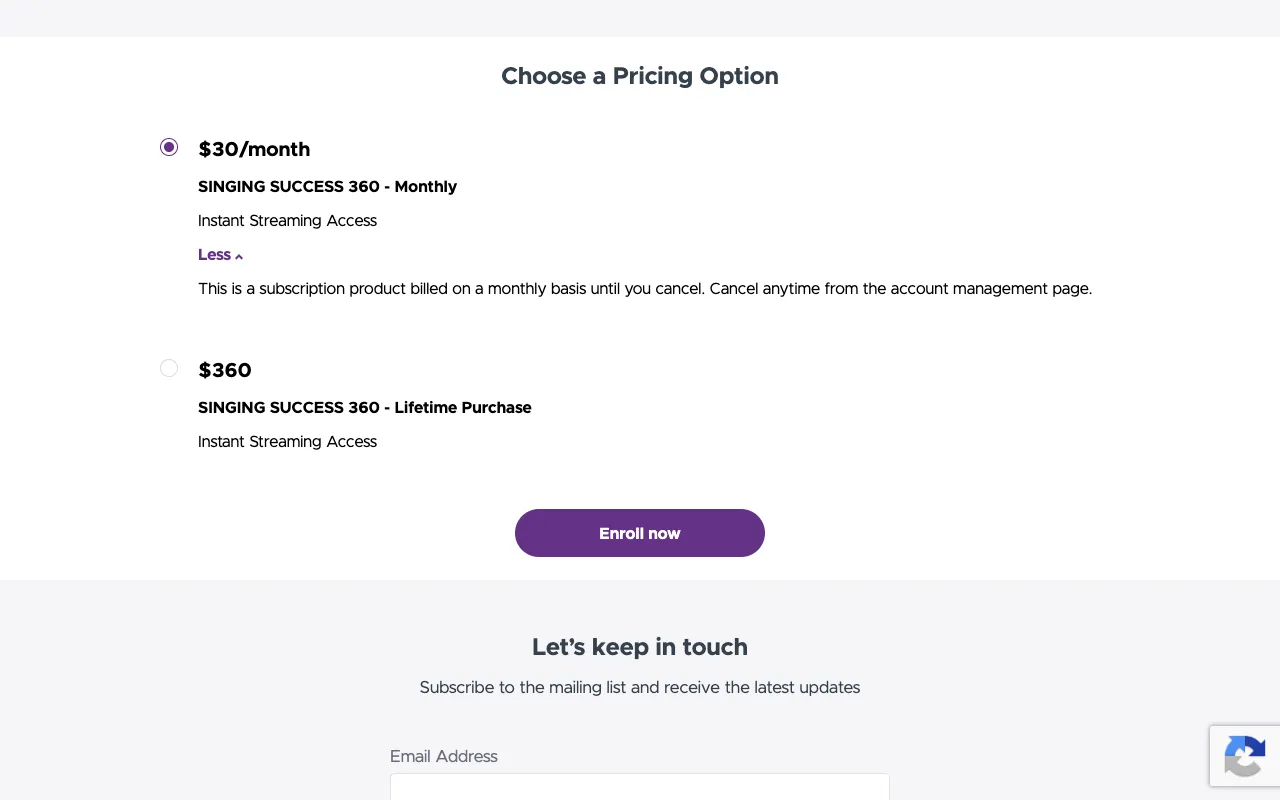
Singing Success 360's two pricing options.Screenshot by Vocal Habit, September 17, 2026.
Good fit for: contemporary singers (pop, country, rock, R&B) who want a teacher-designed video curriculum, with a path to coach access later.
Kind of tool: online video courses from Nashville vocal coach Brett Manning, streamed in the browser on the Teachable course platform, plus a VIP membership and private lessons with his associate coaches. We found no dedicated Singing Success app in the US app stores. The free YouTube channel has about 184,000 subscribers.
In their words: "the voice is a muscle not a mystery." On style: "These aren't traditional opera or musical theater lessons, though they'll help opera and musical theater singers."
The flagship course, Singing Success 360, has 16 video lessons in two halves: technique (from "Discovering Your Voice" through high notes, power, and "The Light Voice") and style (licks and runs, genres, improvisation). Add-on courses go deeper on mix voice, range, vibrato, harmony, and rock singing. There's no automatic pitch feedback. VIP members get a private community with coach Q&A and live warm-ups and masterclasses, and private lessons in Nashville or online are offered through a waitlist.
Price: Singing Success 360 is $30 a month or $360 for lifetime access. VIP is $67 a month and bundles 11 courses with the community and live sessions. Single courses cost $7 to $297, most with a stated 30-day refund; the cheapest is the $7 7-Minute Range Miracle. Private lesson prices aren't published. We found no free trial, though the Singing Success 360 page advertises a money-back guarantee without stating its terms.
Ratings: there's no meaningful public rating. Trustpilot has no reviews and there's no app store listing.
What users like:
•
The exercises, for people who stick with them. "The exercises are good and I could definitely see an improvement," wrote a 2020 r/singing commenter. Another said Singing Success "transformed my singing."
•
Depth: "one of the best. But it's also very intense and covers a LOT of ground," though the same commenter said it's "way too much" for someone just starting out.
What users complain about:
•
No feedback when studying alone. "You'll be stuck trying to guide yourself with no active feedback," one commenter warned, and others say it's easy to do the exercises wrong.
•
Method. The approach is widely described as growing out of Speech Level Singing, and some singers, especially belt-focused ones, disagree with its emphasis on a light mix.
•
Price, compared with lessons from a teacher.
Most public discussion is from 2015 to 2020, before the current streaming and VIP offer.
A health note: Singing Success sells a Vocal Therapy course marketed as helping restore damaged voices. A course isn't medical treatment. If singing hurts or hoarseness hasn't improved within four weeks, see an ENT doctor, who can examine your vocal folds and refer you to a speech-language pathologist if voice therapy fits.
Skip it if: you want automated feedback while you practice, you study classical singing, or you'd rather not pay before trying (there's no trial).
Compared with Vocal Habit: Singing Success has a teacher explaining and modeling technique and style, much deeper material on mix, range, and runs, human coaches through VIP and lessons, and a long track record. Vocal Habit is free, needs no account, and scores your pitch on each note, which covers the pitch part of the "no feedback when studying alone" complaint. It can't judge the registration and tone work the course focuses on.
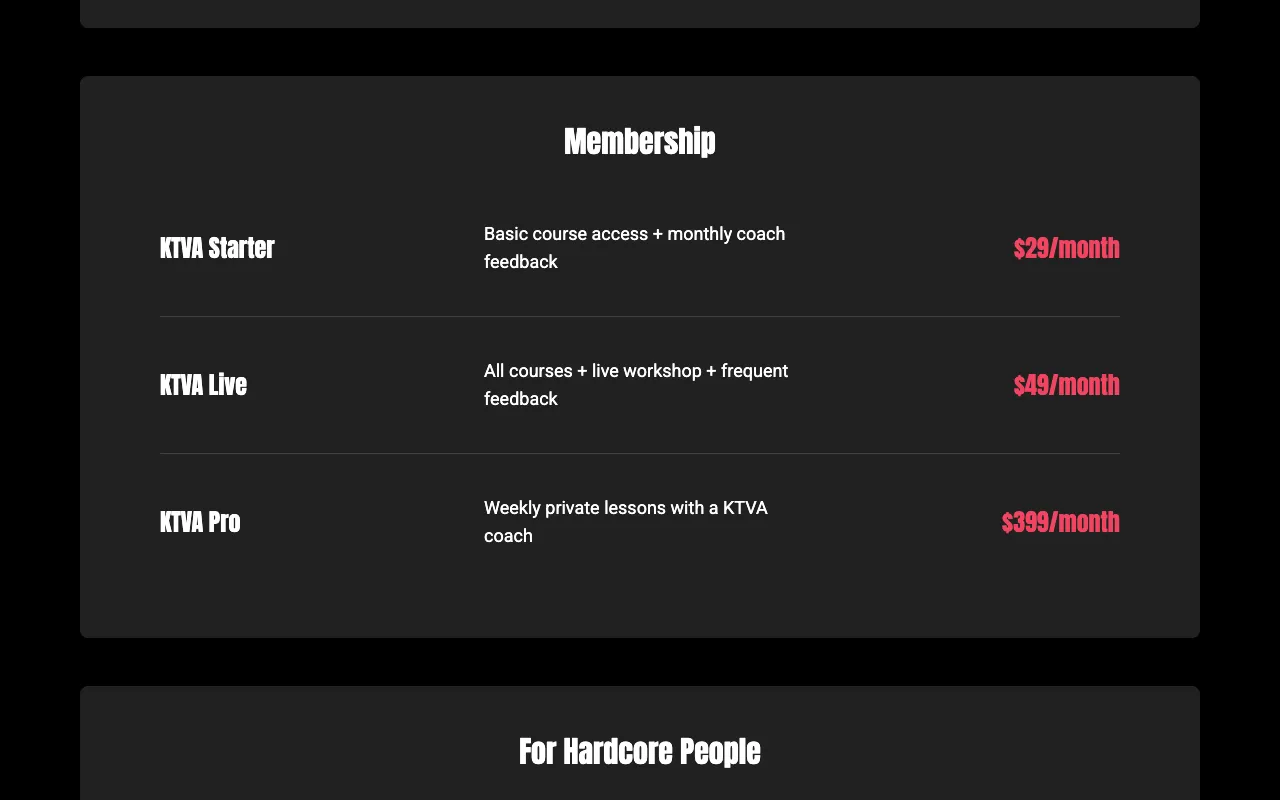
KTVA's three membership tiers.Screenshot by Vocal Habit, September 17, 2026.
Good fit for: committed contemporary singers, especially rock, pop-rock, and belting styles, who want one long structured curriculum and some human feedback without paying for weekly private lessons.
Kind of tool: an online singing school built around Ken Tamplin's video courses, with coaches trained in his method. Web, plus iPhone and Android apps that play the course videos. His free YouTube channel has about 1.28 million subscribers and 2,100 videos.
In their words: "The Most Powerful and Effective Singing Lessons in the World." On method: "Built on 400 years of Bel Canto tradition, modernized for contemporary singing," and "the PROOF is in the singing!"
The flagship course, How To Sing Better Than Anyone Else 3.0, is organized into nine "belts," from diaphragmatic support and open throat up through head voice, passaggio and mix, and compression, each "assessed by a KTVA coach." A shorter course, 30 Minute Singer, is a fixed daily workout. Feedback comes from people. You record yourself and a coach replies on video, or you join live group classes on Zoom. There's no automatic pitch scoring.
Price: the store lists 30 Minute Singer at $49 one-time, KTVA Starter at $29 a month (the first part of the flagship course plus one feedback credit a month), KTVA Live at $49 a month (all four courses, live group classes, and feedback credits), and KTVA Pro at $399 a month (adds a weekly private lesson). A lifetime Forever Pass is $999, and single private lessons with a KTVA coach are $125. Older pages on the site still show different prices, and refund terms differ by product, so read the terms on the page you buy from. KTVA Live currently offers a 7-day trial for $1, and 30 Minute Singer's sales page offers a 365-day money-back guarantee if you send five recordings of the workout.
Ratings: there's no large third-party rating pool. Trustpilot has 1 review, and the course apps have fewer than 30 ratings between them.
What users like:
•
Progress for students who practice for months. A 2021 r/singing commenter wrote: "I've seen miles of improvement from it."
•
Demonstration. Fans value that Ken and his students sing every exercise, so you hear the target sound.
•
A fixed routine for busy adults. One 66-year-old Trustpilot reviewer warned "don't be fooled into being casual about it; it takes real work!"
What users complain about:
•
It can overwhelm. A 2025 student who was glad they did it still said "there is a lot of material, Ken talks fast, and the production style is a bit 'old school.'"
•
Marketing. Critics object to superlative claims such as the flagship course title, and the site stacks "sale" prices against list prices.
•
Style and personality. Some r/singing commenters dislike his own singing and approach, and some see the method as leaning toward his belting rock sound.
KTVA is one of the more polarizing names in online singing instruction, with loyal students and vocal critics. We couldn't find an outside evaluation of the course itself.
A health note: KTVA's Voice Repair course is marketed as helping people recover from nodules and polyps without surgery. The same page states that KTVA "is not a licensed healthcare practitioner and makes no claims or warranties related to your health." ASHA's public information site (run by its affiliate, the Communication Health Support Association) says these growths are diagnosed by an ENT doctor or a speech-language pathologist, that treatment can include voice therapy with a speech-language pathologist, and that surgery is usually reserved for large or long-standing ones. If you think you have a vocal injury, see a doctor first.
Skip it if: you want automated pitch feedback while practicing, you study classical repertoire (KTVA lists musical theatre among its styles, but its demos and reviewers skew toward rock and pop), or superlative marketing and rolling sale prices put you off.
Compared with Vocal Habit: KTVA offers what we can't: coaches who can hear strain and style, live classes, a long demonstrated curriculum, advanced contemporary technique, and a big community. Vocal Habit gives per-note pitch scores after every pattern, for free, with no account and no subscription, which a KTVA student could use for pitch checks between coach reviews.
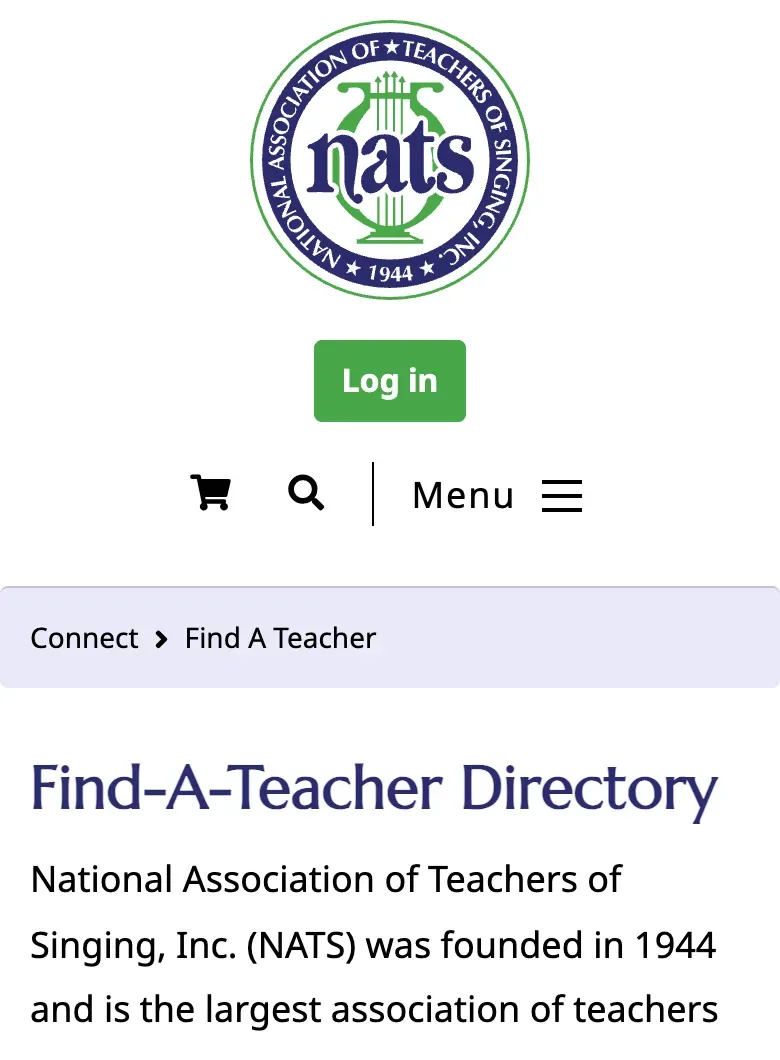
The National Association of Teachers of Singing publishes a searchable member directory.Screenshot by Vocal Habit, September 17, 2026.
Good fit for: anyone serious about singing, anyone with a specific problem (breaks, strain, breathiness), and anyone who has stalled with self-study.
Kind of tool: a person, in a studio or over video call.
A good teacher hears and watches your whole voice: tone, tension, breathing, register changes, vowels, posture, style, and song choice. They can tell you why a note isn't working and change the exercise on the spot. They can also notice warning signs and send you to a doctor. That is what no app on this list can do yet.
Price: there's no national survey from a source without a stake in bookings, so treat these as rough. Community music schools we checked charge $45 to $61 for 30 minutes and $86 to $117 for an hour. Online marketplaces range from under $20 to $50 or more per lesson. Weekly 30-minute lessons at the schools we checked come to roughly $1,500 to $2,800 a year. Many teachers offer a free or discounted trial lesson.
Where to find one:
•
The NATS Find-A-Teacher directory lists members of the National Association of Teachers of Singing. Membership isn't a certification.
Marketplaces such as Lessonface, Preply, Superprof, and Musika. (TakeLessons closed in 2024.)
•
Local community music schools.
Downsides: cost. Quality varies, because no license is generally required to teach singing. Teachers disagree with each other about technique, and a classical teacher may not suit a pop singer. Most of your week is still practice alone. A trial lesson is the most reliable test of fit.
Compared with Vocal Habit: a teacher does far more than we can. Vocal Habit scores pitch on set exercises and can't tell you why a note is off, whether you're straining, or what to sing. What we offer is price (free) and a structured routine you can run every day, whether that's a five-minute warm-up or a half-hour session. For a serious student the two do different jobs, with lessons for direction and a practice tool between them.
Vocal Habit (our tool)
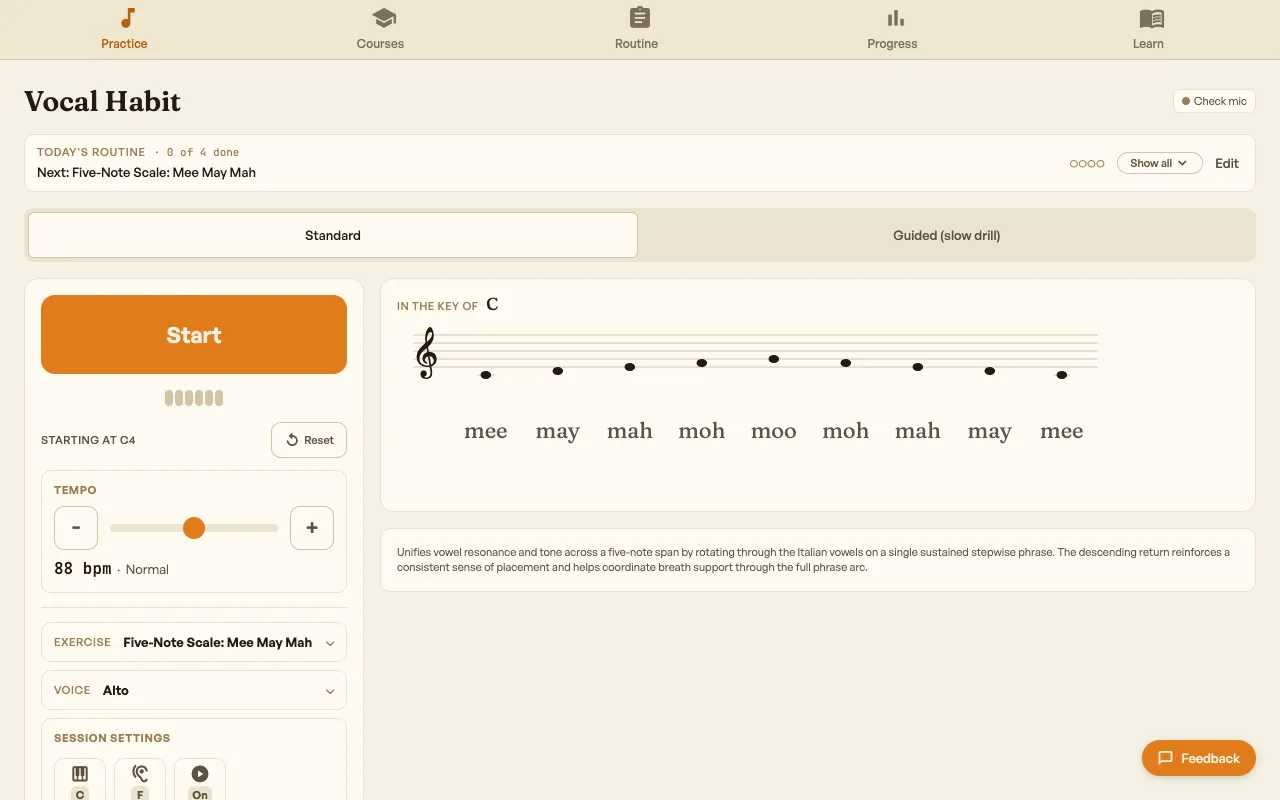
Vocal Habit's practice screen.Screenshot by Vocal Habit, September 17, 2026.
Reminder: this is ours. We've held it to the same template, including the downsides.
Good fit for: beginners and self-taught singers who want a free daily practice routine, from a quick warm-up to a longer technique session, that tells them how in tune they were, with no signup.
Kind of tool: a free web app. It runs in a browser on desktop and phone. No App Store or Google Play app yet.
What we say it is: a practice tool built around a daily exercise routine. You pick your voice part, press Start, and sing along with a piano. After each pattern, it scores each note in cents sharp or flat. You can try one right below.
There are 22 exercises across lip trills and hums, onsets, resonance, chest voice, mix, head voice, agility, belting, vibrato, and dynamics (the hum, lip trill, vibrato, and dynamics exercises are unscored follow-alongs). There's a tempo slider, a slow hold-and-match mode, a daily routine, a free vocal range test, a nine-lesson free beginner course, and a library of articles. You can also record or upload a melody and practice it in segments, and a coaching screen picks out a pitch mistake from your session and plays the target note next to the pitch you actually sang, on the piano.
Price: free. No account, no ads, no trial.
Ratings: none yet. It's a new, small project with no app store listing.
Downsides, plainly:
•
No teacher and no video lessons. Nothing explains technique on camera or answers questions.
•
Feedback is pitch only. It says nothing about tone, breath, resonance, or strain.
•
No native app. It runs in a browser; there's no App Store or Google Play version.
•
No continuous live pitch line. Standard mode scores each note after the pattern, and Guided mode shows live cents on one held note at a time. We left the line out because live readings can jump octaves, but many people learn best by watching one, and most apps on this list have it.
•
No song library.
•
A small exercise library compared with the paid apps.
•
Your history stays in one browser on one device. There's no account and no sync, only a manual backup file.
•
Like every microphone pitch tracker, it can misread low or breathy notes, and it works best with headphones.
•
No outside expert has reviewed it, and we haven't published outcome data.
Skip it if: you want songs, video lessons, or a teacher; you want a continuous live pitch line; you want feedback on tone, breath, or strain; you want your history synced across devices; or you want a native app.
Where it fits: as a free first step, before you know whether you want to pay for anything. As your daily practice between lessons or alongside a course. Or as the thing you use on days you don't open anything else.
SingTrue (iPhone). A gentle pitch-matching and ear-training app, liked by people who think they're tone deaf. We left it off the main list because it hasn't been updated since November 2016, and the lives system limits free practice.
•
Nail the Pitch and Singscope. Pitch visualizers similar to Vocal Pitch Monitor, free to download with in-app purchases.
•
Free YouTube channels. Many voice teachers publish free lessons. They cost nothing, but nobody hears you sing, and quality varies a lot.
What kind of tool do you need?
Most people move through stages. You don't need to buy for the stage after next.
Your first few weeks. The main questions are "can I match a note?" and "what is my range?" Free tools answer both. A pitch monitor, a free range test, or a free practice routine will tell you a lot before you spend anything. If you can't match single notes yet, start there before a song app, since song apps assume you can follow a melody.
Building a habit. Once you are singing most days, structure helps. This is where the paid apps earn their price, with a daily plan, a score to beat, songs you like, and streaks. Expect roughly $60 to $130 a year.
Learning technique. Pitch is only one part of singing. Breath, registration (moving between chest and head voice), tone, and tension are harder to learn from a score. Video courses teach these ideas with a person demonstrating. Apps can't yet reliably tell you why a note went wrong.
Serious study. If you are preparing for auditions, performing, or stuck on a specific problem, a teacher who can hear and watch you is the step up. Weekly lessons cost far more, roughly $1,500 to $2,800 a year for 30 minutes at the community schools we checked, and many serious students keep using an app or pitch monitor for practice between lessons.
Musicianship, at any stage. Hearing intervals, reading notation, and singing harmony are separate skills from vocal technique. Ear-training tools cover them.
How we put this list together
We picked these tools because they come up again and again when people ask where to start: in search results, in app store charts, and in threads on r/singing. We left some out; they are listed under "Also considered" above.
For each tool we read the company's own site, pricing page, help center, and app store listings, and recorded ratings and review counts on the same day. User reviews came from the App Store, Google Play, Trustpilot, and Reddit threads; we looked for complaints and praise that repeat. Third-party reviews are cited where we found them, and reviews written by competing products are flagged as such. Every screenshot was taken by us from public pages.
There are limits to this. We did not buy a subscription to every paid app for this version of the guide. Where we describe a paid feature, we are going by the company's own description and by what paying users report. We did not run our own accuracy test on anyone's pitch detection, so we make no claims about which app is most accurate.
Ratings need some care. Store reviews skew toward very happy and very annoyed people, several apps ask for a rating early, and Reddit skews toward hobbyists who already sing. Treat every star rating in this guide as a rough signal.
Do singing apps work, or do you need a teacher?
Teachers and researchers disagree here. These are the main positions.
The case for pitch-feedback apps. Controlled lab studies support seeing your pitch in real time as a practice aid, though they tested research software, not the apps on this list. In a 2021 randomized study of adults who had trouble singing in tune, all groups improved a little, but only the group given real-time visual pitch feedback during a single 20-minute session improved significantly (Berglin, Pfordresher, and Demorest). A 2021 lab study of people with no musical experience, who practiced matching a synthesized tone with their voice or a violin, found that two kinds of feedback both helped during training, but only the group given real-time visual feedback kept its gains in a later transfer test (Blanco and colleagues). Apps are also cheap and available every day, which matters when lessons cost $50 each.
The case for caution. Those studies measure pitch accuracy over short training, not tone, healthy technique, or long-term progress, and none compares an app with a teacher; we found no study that does. The closest studies add technology to regular lessons, with mixed results: students at three Chinese arts universities who also used two vocal apps scored higher than classmates who didn't (Han, 2023), while adding an AI feedback tool to six weeks of lessons made no measurable difference to singing (Li and colleagues, 2025). Some teachers argue that watching a display trains the wrong skill: VoSci's position is that it builds dependence on the tool instead of your inner sense of the note, and some Vocal Pitch Monitor users describe exactly that. A voice teacher on r/singing also points out that self-study programs can go wrong when a student misreads an instruction and has no one to catch it. A 2022 overview of real-time visual feedback in singing (Lã and Fiuza) discusses these displays, from pitch to breathing and vocal-fold contact, as tools for the voice studio and singing lessons.
Where that leaves you. A common middle position, which even some app makers state, is that pitch feedback is a useful practice aid, especially early on, and a teacher adds things no current app can. How much you need each depends on your goals and budget. If singing hurts, or hoarseness hasn't cleared up or improved within four weeks, see a doctor, ideally an ENT who specializes in voice. Go sooner if you sing professionally, smoke, have trouble breathing, or notice a lump in your neck.
FAQ
Are there free apps to learn singing?
It depends on what you need. Singing Carrots has free range, pitch, and song-search tools on the web. Sing Sharp has a limited free version with ads. Vocal Pitch Monitor draws a free live pitch graph on Android. ToneGym gives three free ear-training games a day plus a free range test. VoSci offers a free science library and measurement tools with a free account. Vocal Habit (ours) gives free per-note pitch scores on practice exercises with no signup. Song-based apps are mostly paid. Simply Sing's free tier stops at the range test, and Yousician's is a small sample.
Can an app really teach you to sing?
An app can help you practice, especially pitch. Short lab studies found that seeing your pitch in real time helped people sing more in tune, though they tested research software, not the apps on this list. No current app can hear tension, judge tone, or tell you why a note isn't working the way a teacher can, so many singers use an app between lessons.
Which singing app is the most accurate?
We don't know of a third-party test comparing them, and we didn't run one. Microphone pitch trackers can jump an octave, especially on low or gravelly notes, and can drop out on breathy ones. Apps that play backing music or a piano while you sing generally track better with headphones, so the microphone isn't also hearing the accompaniment.
Is Simply Sing or Yousician better for singing?
Simply Sing is singing-only and song-first, with every song moved to your key, at roughly $60 to $90 a year in the US. Yousician has a more lesson-based singing path and covers five instruments, but singing alone costs $119.99 a year on the App Store. If you only want to sing songs, Simply Sing is simpler. If you also play guitar or piano, Yousician's Premium+ covers both.
How much do singing lessons cost?
In the US, roughly $40 to $60 for 30 minutes with an established local teacher or community music school, and $80 to $120 for an hour. Online marketplaces list teachers for less, with wider variation. Weekly 30-minute lessons at the community music schools we checked come to roughly $1,500 to $2,800 a year.
Are paid singing apps worth it?
They can be, if the structure keeps you practicing. Start with free tools to learn whether you'll sing most days, then pay for the kind of structure you're missing: songs, a program, or a teacher on video. Watch for trials that convert to a yearly charge.
Berglin J, Pfordresher PQ, Demorest S. "The effect of visual and auditory feedback on adult poor-pitch remediation." Psychology of Music. 2022;50(4):1077-1090 (published online 2021). https://doi.org/10.1177/03057356211026730
•
Blanco AD, Tassani S, Ramírez R. "Effects of Visual and Auditory Feedback in Violin and Singing Voice Pitch Matching Tasks." Frontiers in Psychology. 2021;12:684693. https://doi.org/10.3389/fpsyg.2021.684693
Li W, Cui X, Manoharan P, et al. "AI-assisted feedback and reflection in vocal music training: effects on metacognition and singing performance." Frontiers in Psychology. 2025. https://doi.org/10.3389/fpsyg.2025.1598867
•
Lã FMB, Fiuza MB. "Real-Time Visual Feedback in Singing Pedagogy: Current Trends and Future Directions." Applied Sciences. 2022;12(21):10781. https://doi.org/10.3390/app122110781
•
Stachler RJ, et al. "Clinical Practice Guideline: Hoarseness (Dysphonia) (Update)." Otolaryngology-Head and Neck Surgery. 2018;158(1_suppl):S1-S42. https://pubmed.ncbi.nlm.nih.gov/29494321/